


β-Relaxation and Residual Stress Evolution in Glass-to-Metal Seals
β-relaxation residual stress in glass-to-metal seals is not a secondary design consideration — it is a primary failure mechanism that determines whether a hermetic seal survives its thermal environment. This structural relaxation process governs how internally trapped stresses evolve during thermal cycling, and for engineers designing GTMS for aerospace, defense, or medical applications, understanding it is the difference between a seal that holds and one that does not.
What Is β-Relaxation in Glass-to-Metal Seals?
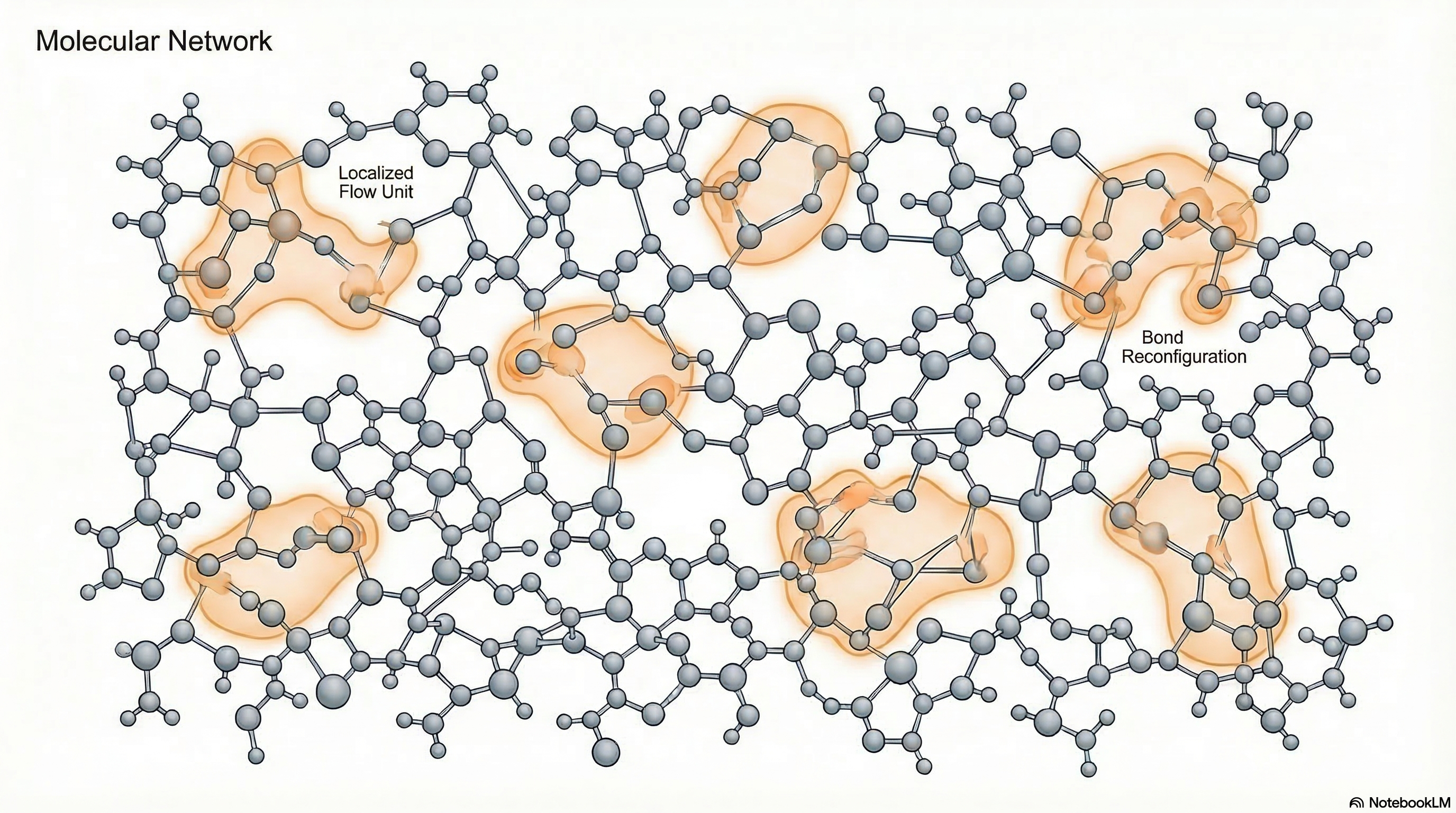
β-relaxation is a sub-glass-transition structural relaxation process driven by the activation of nano-localized flow units within the glass network. Unlike α-relaxation, which occurs at or above the glass transition temperature (Tg) and involves large-scale molecular rearrangement, β-relaxation operates at lower temperatures through highly localized atomic motion. As glass is heated, these nano-localized units begin to move, facilitating the breaking and rebuilding of chemical bonds within the molecular network. This rearrangement is the mechanism by which internally trapped stresses are released — altering the macroscopic stress state of the seal before Tg is ever reached.
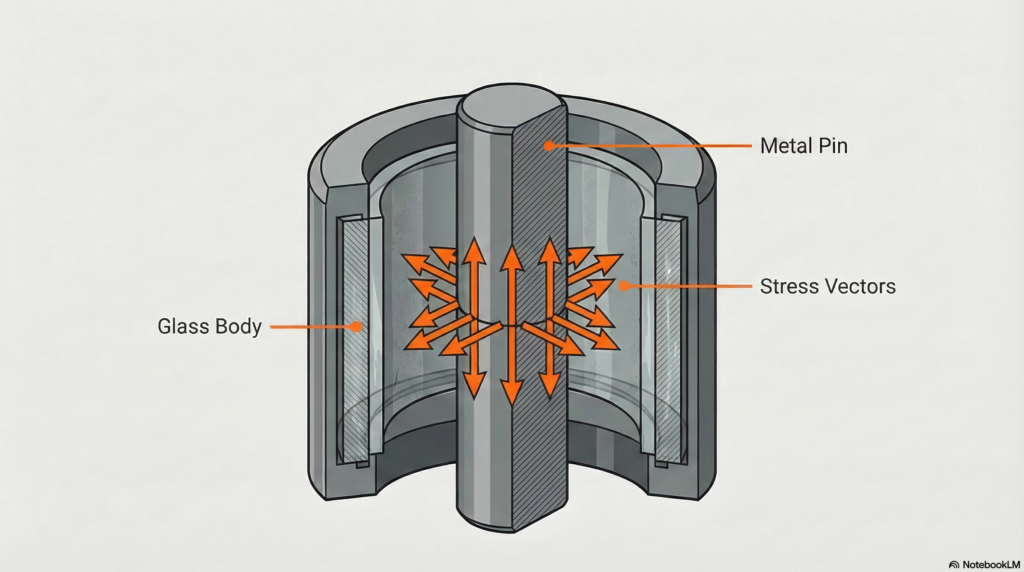
How β-Relaxation Drives Residual Stress Evolution
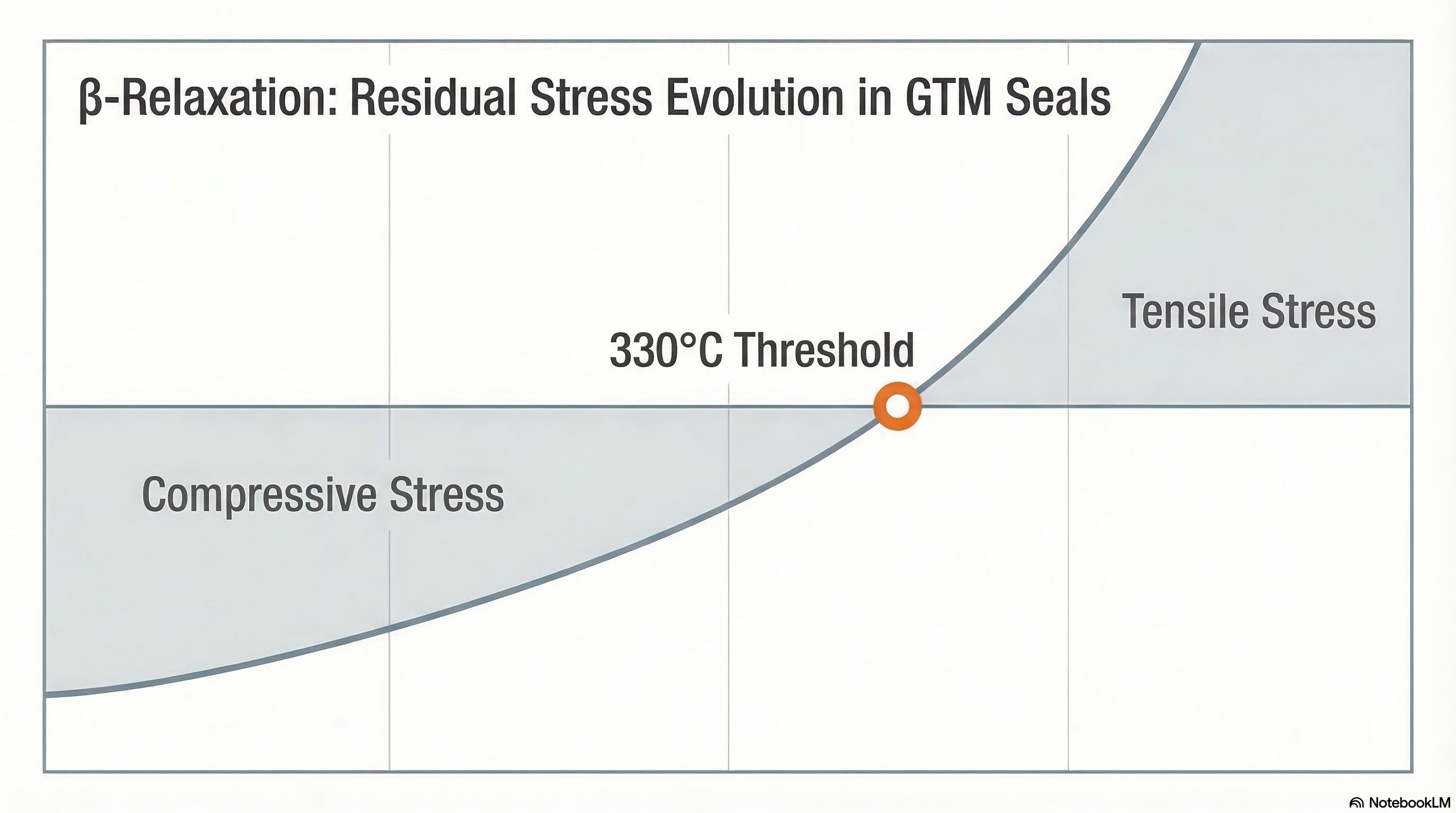
In a typical GTM seal, the glass body starts in a state of compressive residual stress — a condition that is generally protective, because glass is significantly stronger in compression than in tension. As temperature rises, β-relaxation triggers a sharp reduction in that compressive stress. Finite Element Analysis (FEA) and in situ experimental observations of borosilicate glass seals show that this process can drive the glass into a tensile stress state once temperatures exceed approximately 330°C.
This compressive-to-tensile transition is the critical threshold. Once the glass enters the tensile regime, its structural resistance drops substantially, and any pre-existing flaws in the glass body or at the glass-metal interface become sites of elevated risk.
IN THE IMAGE UNDERNEATH CHANGE TO “Above 330C Threshold“
Failure Modes Triggered by Uncontrolled Stress Relaxation
Uncontrolled β-relaxation creates three distinct failure pathways in GTM hermetic seals.
Rapid internal stress shifts can initiate micro-cracks near the glass-metal interface, particularly where CTE mismatch concentrates stress. Pre-existing flaws — including inclusions, voids, or surface defects — can propagate as the compressive protection is lost and the glass transitions into tension. If structural instability develops at elevated temperatures, the result is a hermetic breach detectable by helium mass spectrometry. For applications governed by MIL-STD-883 or equivalent leak test standards, this represents a qualification failure.
Engineering for Controlled Relaxation
Designing GTMS that survive β-relaxation requires moving beyond static CTE matching into dynamic thermal stress management. By characterizing stress evolution through steady-state static analysis and using temperature-calibrated Young’s modulus values, engineers can optimize heating and cooling profiles to keep structural relaxation controlled across the full operational thermal range.
Material architecture is as important as material selection. The geometry of the seal, the glass composition, and the interface between glass and metal all determine how and where stress relaxes. Hermetron’s GlassTomer™ technology addresses this challenge through its adhesive polymer chemistry, which distributes stress dynamically across the seal interface rather than concentrating it at the glass-metal boundary. This provides inherent resilience to the compressive-to-tensile transitions that compromise traditional borosilicate glass seals — and has been validated across more than 100,000 units delivered to aerospace and defense programs with zero reported field failures.
Conclusion
The long-term integrity of a hermetic seal is governed by a complex, evolving triaxial stress state — not a static snapshot taken at room temperature. β-relaxation residual stress in glass-to-metal seals is the primary mechanism that disrupts that state under thermal load, and accounting for it at the design stage is what separates seals that perform across their full service life from those that fail unpredictably.
For applications that require hermetic integrity across wide thermal cycles, Hermetron’s engineering team works directly with customers to specify and manufacture GTMS assemblies engineered for controlled relaxation behavior.
FAQs
β-relaxation is a sub-glass-transition structural relaxation process in glass, driven by the activation of nano-localized flow units within the molecular network. In glass-to-metal hermetic seals, β-relaxation is significant because it allows internally trapped residual stresses to evolve at temperatures well below Tg — altering the stress state of the seal during normal thermal cycling. Hermetron accounts for this phenomenon in the design and qualification of GTMS assemblies for aerospace and defense applications.
In borosilicate glass-to-metal seals, FEA modeling and in situ observations show that β-relaxation can drive the glass from a compressive to a tensile stress state at temperatures exceeding approximately 330°C. This threshold varies with glass composition and seal geometry, but the transition into tension represents the highest-risk window for crack initiation and hermetic failure because glass is substantially weaker in tension than compression.
Uncontrolled β-relaxation causes three failure pathways: micro-crack initiation at the glass-metal interface, propagation of pre-existing flaws as compressive protection is lost, and hermetic breach detectable under MIL-STD-883 helium leak testing. The failure is driven not by the relaxation itself but by the rate and spatial distribution of stress release — if relaxation is too rapid or uneven, the glass cannot accommodate the internal pressure shift without fracture.
Controlling β-relaxation in GTMS requires characterizing stress evolution through FEA with temperature-calibrated Young’s modulus values, then optimizing thermal processing profiles to keep relaxation rates within structural limits. Material architecture — including glass composition, seal geometry, and interface design — plays an equally important role. Hermetron’s GlassTomer™ technology uses adhesive polymer chemistry to distribute stress dynamically across the seal interface, reducing the concentration of tensile stress that would otherwise develop at the glass-metal boundary during thermal excursions.
Hermetic integrity in GTMS assemblies is verified by helium mass spectrometry leak testing, typically performed to MIL-STD-883 Method 1014 or equivalent standards. This test detects vacuum leaks that develop as a result of structural instability — including micro-cracks triggered by β-relaxation during thermal cycling. Hermetron qualifies its hermetic assemblies to AS9100D with ISO 9001:2015, and leak testing is a standard step in the production and qualification process.